
Launch your token. Claim your crown. Get verified, listed, and reconignzed across every chains.

Launch your token. Claim your crown. Get verified, listed and recognized across every chains.
Launch your token. Claim your crown. Get verified, listed, and reconignzed across every chains.
Launch your token. Claim your crown. Get verified, listed and recognized across every chains.
mobula
© 2025 Mobula. All rights reserved.
Back to top
How ChainDaddy cut search latency from 2 000ms to 50ms by replacing 6 data providers (Coingecko, DEXScreener, GeckoTerminal, Helius, Etherscan, pump.fun) with Mobula
Chaindaddy is a trustless ticker symbol registry a product that lets crypto projects claim ownership of their token symbol as a soulbound NFT. To power search and token enrichment across 7 blockchains and 50,000+ tokens, they had stitched together six separate data providers. The result: every user search triggered 3–4 parallel API calls, inconsistent data formats to normalize, and a search latency of ~2,000ms.
After integrating Mobula, search latency dropped to under 50ms and Six integrations became one.

The problem: data fragmentation at scale
Building a multi-chain token registry means pulling data from everywhere market prices, banners, descriptions, CEX listings, holder counts, security flags. Chain Daddy had a provider for each:
| Provider | Used for | Pain |
|---|---|---|
| CoinGecko | Market data, metadata | $400/month, rate limits, incomplete Solana |
| DEXScreener | Banners, price changes | 2 RPS cap, no bulk API |
| GeckoTerminal | Descriptions, socials | Often stale |
| Helius | Solana metadata | Solana only |
| Etherscan / Arbiscan | Deployer, timestamps | Per-chain, rate limited |
| Pump.fun | Bonding curve data | Solana only, proprietary |
Every search hit three or four of these simultaneously. When DEXScreener throttled at 2 RPS, searches stalled. When CoinGecko returned a 429, the cascade broke the whole response. The codebase accumulated ~500 lines of provider-specific normalization logic a maintenance burden that grew with every new chain they supported.
Some data they needed simply did not exist across any of these providers. CEX listings for a token whether it trades on Binance, Coinbase, or OKX required custom scraping. Token security data (buy/sell tax, honeypot detection, LP lock status) was not available at all.
Chain Daddy integrated Mobula across three tiers, each serving a distinct part of their pipeline.
Tier 1: Daily catalog sync
Once a day, a single call to /api/1/all pulls the full 32,000+ token catalog — logos, market data, contract addresses, socials — into their local tokens table. Five credits. One request. The entire Mobula dataset as a foundation.
Tier 2: async search enrichment
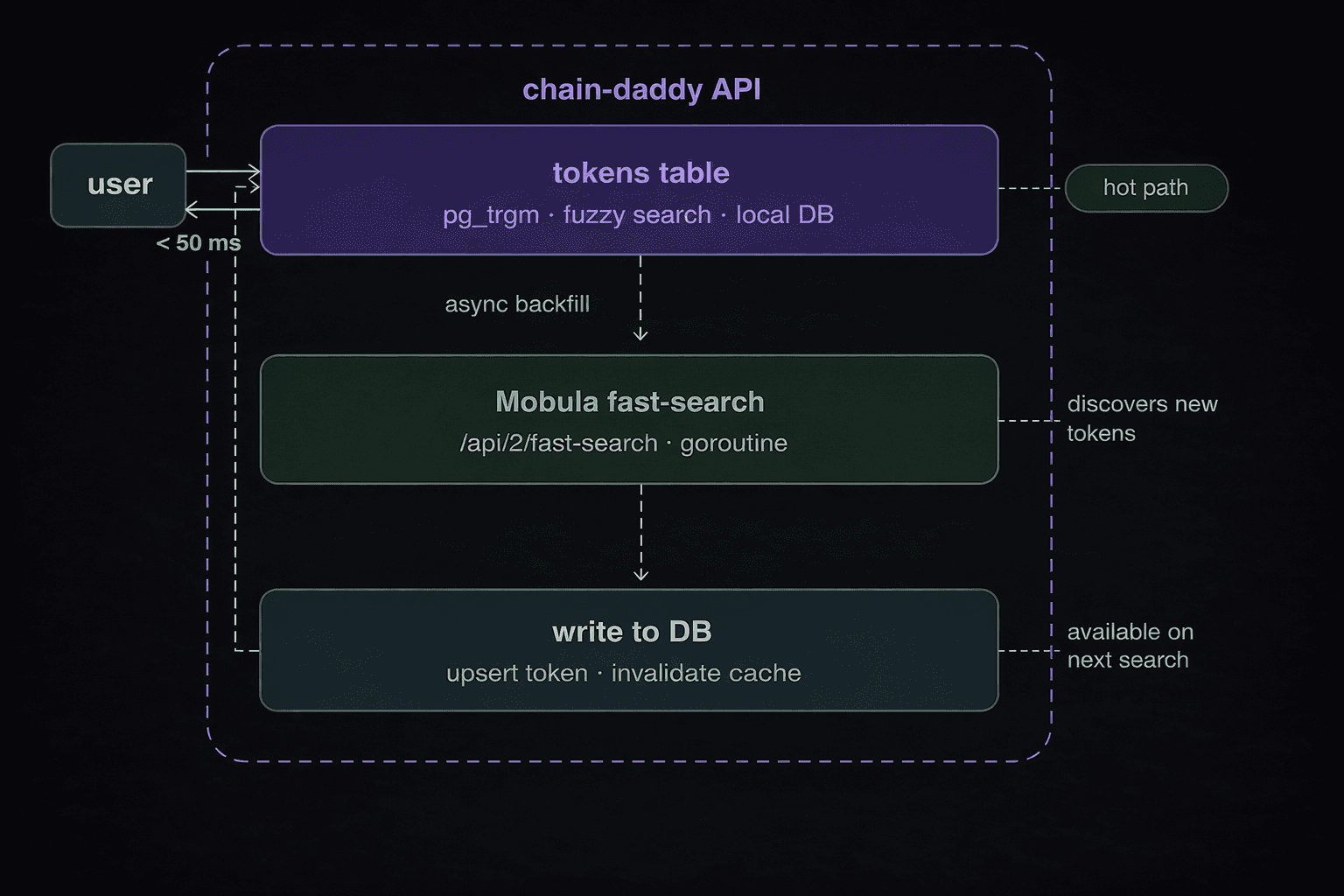
This is where the architecture changed most fundamentally. Previously, every user search triggered live calls to multiple providers. Now, the search response comes entirely from a local PostgreSQL table with pg_trgm fuzzy matching — returning in under 50ms with no external dependency.
After the response is already sent, a Go goroutine fires a background call to /api/2/fast-search. If Mobula returns tokens not yet in the local database — newly launched tokens, recently listed pairs they get written in and the cache gets invalidated. The next search includes them automatically.
The /api/2/fast-search endpoint delivers everything Chain Daddy previously needed six providers for:
dexscreenerHeaderbanner image, replacing DEXScreenercexsCEX listings (Binance, Coinbase, OKX…), data that simply wasn't available beforesecuritybuy/sell tax, honeypot flag, LP lock status, data that wasn't available beforeholdersCountreplacing per-token on-chain RPC callsdescription,socialsreplacing GeckoTerminalPrice changes and volumes across all timeframes from 1 minute to 24 hours
Tier 3: proactive enrichment
Tokens discovered via Helius and Alchemy webhooks arrive as bare rows in the database. A background worker polls every 60 seconds for unenriched tokens and calls /api/1/token/metadata to fill them in full tokenomics, vesting schedules, KYC, audit status, CEX listings. One credit per token.
For bulk backfill operations, /api/2/token/details handles batch requests via POST, returning the complete picture: holder distribution breakdowns, organic trade metrics, security flags, and fee data.
How Mobula solved it
The architecture, before and after
Before: three external API calls on every search, merged in real time, cascading on any provider failure.
After: search is a local database query. Mobula runs entirely off the critical path, in the background.
The pattern eliminates the performance dependency on external APIs entirely. Mobula's availability and latency no longer affect the user-facing response time.
The results
| Metric | Before | After |
|---|---|---|
| Search latency | ~2,000 ms | < 50 ms |
| External calls on hot path | 3–4 per search | 0 |
| Data providers to maintain | 6 | 1 |
| Lines of provider-specific code removed | ~500 | |
| CEX listings available | No | Yes |
| Token security data available | No | Yes |
Endpoints used
| Endpoint | Credits | Use case | Docs |
|---|---|---|---|
| GET /api/1/all | 5 | Full catalog sync (daily) | docs |
| GET /api/2/fast-search | 5 | Async enrichment after each search | docs |
| GET /api/1/market/query | 10/500 | Per-chain banner backfill | docs |
| GET /api/1/token/metadata | 1 | Background enrichment worker | docs |
| GET /api/2/token/details | 1/token | Batch CLI backfill | docs |
What's next
Chain Daddy is evaluating Mobula's Pulse V2 WebSocket for real-time token discovery
a path that would replace the current Helius/Alchemy webhook setup (currently costing $250+/month) with a single Mobula stream.
They are also looking at Mobula webhooks for swap and transfer events as a complement to Alchemy on the EVM side.
How Chaindaddy cut search latency from 2 000ms to 50 ms by replacing 6 data providers with (Coingecko, DEXScreener, GeckoTerminal, Helius, Etherscan, pump.fun) with Mobula
Chaindaddy is a trustless ticker symbol registry a product that lets crypto projects claim ownership of their token symbol as a soulbound NFT. To power search and token enrichment across 7 blockchains and 50,000+ tokens, they had stitched together six separate data providers. The result: every user search triggered 3–4 parallel API calls, inconsistent data formats to normalize, and a search latency of ~2,000ms.
After integrating Mobula, search latency dropped to under 50ms and Six integrations became one.
The problem: data fragmentation at scale
Building a multi-chain token registry means pulling data from everywhere market prices, banners, descriptions, CEX listings, holder counts, security flags. Chain Daddy had a provider for each:
| Provider | Used for | Pain |
|---|---|---|
| CoinGecko | Market data, metadata | $400/month, rate limits, incomplete Solana |
| DEXScreener | Banners, price changes | 2 RPS cap, no bulk API |
| GeckoTerminal | Descriptions, socials | Often stale |
| Helius | Solana metadata | Solana only |
| Etherscan / Arbiscan | Deployer, timestamps | Per-chain, rate limited |
| Pump.fun | Bonding curve data | Solana only, proprietary |
Every search hit three or four of these simultaneously. When DEXScreener throttled at 2 RPS, searches stalled. When CoinGecko returned a 429, the cascade broke the whole response. The codebase accumulated ~500 lines of provider-specific normalization logic a maintenance burden that grew with every new chain they supported.
Some data they needed simply did not exist across any of these providers. CEX listings for a token whether it trades on Binance, Coinbase, or OKX required custom scraping. Token security data (buy/sell tax, honeypot detection, LP lock status) was not available at all.
Chain Daddy integrated Mobula across three tiers, each serving a distinct part of their pipeline.
Tier 1: Daily catalog sync
Once a day, a single call to /api/1/all pulls the full 32,000+ token catalog — logos, market data, contract addresses, socials — into their local tokens table. Five credits. One request. The entire Mobula dataset as a foundation.
Tier 2: async search enrichment
This is where the architecture changed most fundamentally. Previously, every user search triggered live calls to multiple providers. Now, the search response comes entirely from a local PostgreSQL table with pg_trgm fuzzy matching — returning in under 50ms with no external dependency.
After the response is already sent, a Go goroutine fires a background call to /api/2/fast-search. If Mobula returns tokens not yet in the local database — newly launched tokens, recently listed pairs they get written in and the cache gets invalidated. The next search includes them automatically.
The /api/2/fast-search endpoint delivers everything Chain Daddy previously needed six providers for:
dexscreenerHeaderbanner image, replacing DEXScreenercexsCEX listings (Binance, Coinbase, OKX…), data that simply wasn't available beforesecuritybuy/sell tax, honeypot flag, LP lock status, data that wasn't available beforeholdersCountreplacing per-token on-chain RPC callsdescription,socialsreplacing GeckoTerminalPrice changes and volumes across all timeframes from 1 minute to 24 hours
Tier 3: proactive enrichment
Tokens discovered via Helius and Alchemy webhooks arrive as bare rows in the database. A background worker polls every 60 seconds for unenriched tokens and calls /api/1/token/metadata to fill them in full tokenomics, vesting schedules, KYC, audit status, CEX listings. One credit per token.
For bulk backfill operations, /api/2/token/details handles batch requests via POST, returning the complete picture: holder distribution breakdowns, organic trade metrics, security flags, and fee data.
Chain Daddy integrated Mobula across three tiers, each serving a distinct part of their pipeline.
Tier 1: Daily catalog sync
Once a day, a single call to /api/1/all pulls the full 32,000+ token catalog — logos, market data, contract addresses, socials — into their local tokens table. Five credits. One request. The entire Mobula dataset as a foundation.
Tier 2: async search enrichment
This is where the architecture changed most fundamentally. Previously, every user search triggered live calls to multiple providers. Now, the search response comes entirely from a local PostgreSQL table with pg_trgm fuzzy matching — returning in under 50ms with no external dependency.
After the response is already sent, a Go goroutine fires a background call to /api/2/fast-search. If Mobula returns tokens not yet in the local database — newly launched tokens, recently listed pairs they get written in and the cache gets invalidated. The next search includes them automatically.
The /api/2/fast-search endpoint delivers everything Chain Daddy previously needed six providers for:
dexscreenerHeaderbanner image, replacing DEXScreenercexsCEX listings (Binance, Coinbase, OKX…), data that simply wasn't available beforesecuritybuy/sell tax, honeypot flag, LP lock status, data that wasn't available beforeholdersCountreplacing per-token on-chain RPC callsdescription,socialsreplacing GeckoTerminalPrice changes and volumes across all timeframes from 1 minute to 24 hours
Tier 3: proactive enrichment
Tokens discovered via Helius and Alchemy webhooks arrive as bare rows in the database. A background worker polls every 60 seconds for unenriched tokens and calls /api/1/token/metadata to fill them in full tokenomics, vesting schedules, KYC, audit status, CEX listings. One credit per token.
For bulk backfill operations, /api/2/token/details handles batch requests via POST, returning the complete picture: holder distribution breakdowns, organic trade metrics, security flags, and fee data.
How Mobula solved it
The architecture, before and after
Before: three external API calls on every search, merged in real time, cascading on any provider failure.
After: search is a local database query. Mobula runs entirely off the critical path, in the background.
The pattern eliminates the performance dependency on external APIs entirely. Mobula's availability and latency no longer affect the user-facing response time.
The results
| Metric | Before | After |
|---|---|---|
| Search latency | ~2,000 ms | < 50 ms |
| External calls on hot path | 3–4 per search | 0 |
| Data providers to maintain | 6 | 1 |
| Lines of provider-specific code removed | ~500 | |
| CEX listings available | No | Yes |
| Token security data available | No | Yes |
Endpoints used
| Endpoint | Credits | Use case | Docs |
|---|---|---|---|
| GET /api/1/all | 5 | Full catalog sync (daily) | docs |
| GET /api/2/fast-search | 5 | Async enrichment after each search | docs |
| GET /api/1/market/query | 10/500 | Per-chain banner backfill | docs |
| GET /api/1/token/metadata | 1 | Background enrichment worker | docs |
| GET /api/2/token/details | 1/token | Batch CLI backfill | docs |
What's next
Chain Daddy is evaluating Mobula's Pulse V2 WebSocket for real-time token discovery
a path that would replace the current Helius/Alchemy webhook setup (currently costing $250+/month) with a single Mobula stream.
They are also looking at Mobula webhooks for swap and transfer events as a complement to Alchemy on the EVM side.
How Chaindaddy cut search latency from 2 000ms to 50 ms by replacing 6 data providers (Coingecko, DEXScreener, GeckoTerminal, Helius, Etherscan, pump.fun)) with Mobula
Chaindaddy is a trustless ticker symbol registry a product that lets crypto projects claim ownership of their token symbol as a soulbound NFT. To power search and token enrichment across 7 blockchains and 50,000+ tokens, they had stitched together six separate data providers. The result: every user search triggered 3–4 parallel API calls, inconsistent data formats to normalize, and a search latency of ~2,000ms.
After integrating Mobula, search latency dropped to under 50ms and Six integrations became one.
The problem: data fragmentation at scale
Building a multi-chain token registry means pulling data from everywhere market prices, banners, descriptions, CEX listings, holder counts, security flags. Chain Daddy had a provider for each:
| Provider | Used for | Pain |
|---|---|---|
| CoinGecko | Market data, metadata | $400/month, rate limits, incomplete Solana |
| DEXScreener | Banners, price changes | 2 RPS cap, no bulk API |
| GeckoTerminal | Descriptions, socials | Often stale |
| Helius | Solana metadata | Solana only |
| Etherscan / Arbiscan | Deployer, timestamps | Per-chain, rate limited |
| Pump.fun | Bonding curve data | Solana only, proprietary |
Every search hit three or four of these simultaneously. When DEXScreener throttled at 2 RPS, searches stalled. When CoinGecko returned a 429, the cascade broke the whole response. The codebase accumulated ~500 lines of provider-specific normalization logic a maintenance burden that grew with every new chain they supported.
Some data they needed simply did not exist across any of these providers. CEX listings for a token whether it trades on Binance, Coinbase, or OKX required custom scraping. Token security data (buy/sell tax, honeypot detection, LP lock status) was not available at all.
Chain Daddy integrated Mobula across three tiers, each serving a distinct part of their pipeline.
Tier 1: Daily catalog sync
Once a day, a single call to /api/1/all pulls the full 32,000+ token catalog — logos, market data, contract addresses, socials — into their local tokens table. Five credits. One request. The entire Mobula dataset as a foundation.
Tier 2: async search enrichment
This is where the architecture changed most fundamentally. Previously, every user search triggered live calls to multiple providers. Now, the search response comes entirely from a local PostgreSQL table with pg_trgm fuzzy matching — returning in under 50ms with no external dependency.
After the response is already sent, a Go goroutine fires a background call to /api/2/fast-search. If Mobula returns tokens not yet in the local database — newly launched tokens, recently listed pairs they get written in and the cache gets invalidated. The next search includes them automatically.
The /api/2/fast-search endpoint delivers everything Chain Daddy previously needed six providers for:
dexscreenerHeaderbanner image, replacing DEXScreenercexsCEX listings (Binance, Coinbase, OKX…), data that simply wasn't available beforesecuritybuy/sell tax, honeypot flag, LP lock status, data that wasn't available beforeholdersCountreplacing per-token on-chain RPC callsdescription,socialsreplacing GeckoTerminalPrice changes and volumes across all timeframes from 1 minute to 24 hours
Tier 3: proactive enrichment
Tokens discovered via Helius and Alchemy webhooks arrive as bare rows in the database. A background worker polls every 60 seconds for unenriched tokens and calls /api/1/token/metadata to fill them in full tokenomics, vesting schedules, KYC, audit status, CEX listings. One credit per token.
For bulk backfill operations, /api/2/token/details handles batch requests via POST, returning the complete picture: holder distribution breakdowns, organic trade metrics, security flags, and fee data.
How Mobula solved it
The architecture, before and after
Before: three external API calls on every search, merged in real time, cascading on any provider failure.
After: search is a local database query. Mobula runs entirely off the critical path, in the background.
The pattern eliminates the performance dependency on external APIs entirely. Mobula's availability and latency no longer affect the user-facing response time.
The results
| Metric | Before | After |
|---|---|---|
| Search latency | ~2,000 ms | < 50 ms |
| External calls on hot path | 3–4 per search | 0 |
| Data providers to maintain | 6 | 1 |
| Lines of provider-specific code removed | ~500 | |
| CEX listings available | No | Yes |
| Token security data available | No | Yes |
Endpoints used
| Endpoint | Credits | Use case | Docs |
|---|---|---|---|
| GET /api/1/all | 5 | Full catalog sync (daily) | docs |
| GET /api/2/fast-search | 5 | Async enrichment after each search | docs |
| GET /api/1/market/query | 10/500 | Per-chain banner backfill | docs |
| GET /api/1/token/metadata | 1 | Background enrichment worker | docs |
| GET /api/2/token/details | 1/token | Batch CLI backfill | docs |
What's next
Chain Daddy is evaluating Mobula's Pulse V2 WebSocket for real-time token discovery
a path that would replace the current Helius/Alchemy webhook setup (currently costing $250+/month) with a single Mobula stream.
They are also looking at Mobula webhooks for swap and transfer events as a complement to Alchemy on the EVM side.
4157A1